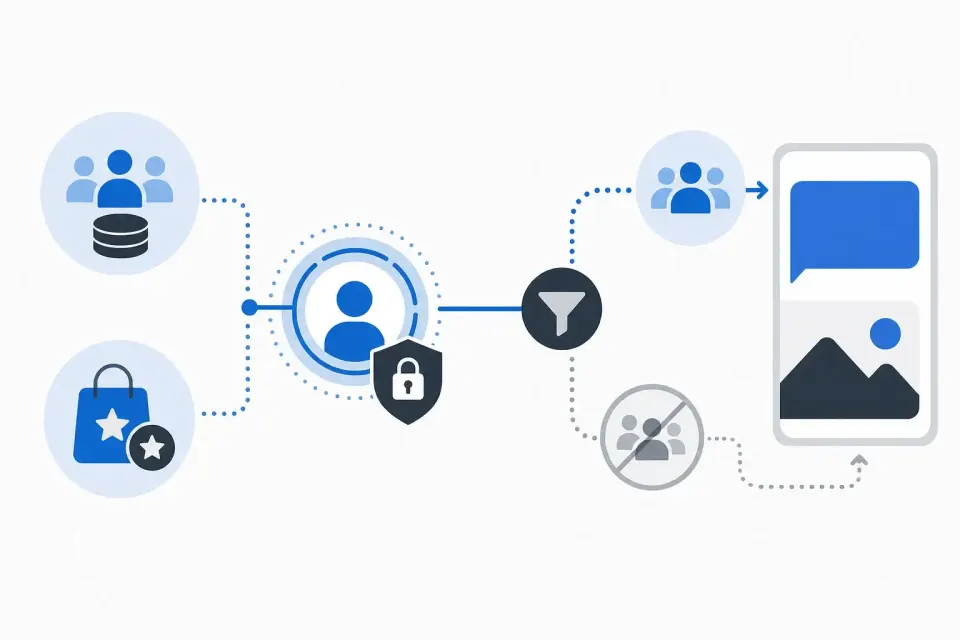
LiveRamp has expanded its ChatGPT Ads integration beyond conversion measurement to include first-party audience activation, allowing marketers to use RampID-linked CRM, loyalty, behavioral, web and app data to build Custom Audiences in 11 markets, with broader expansion planned.
Growth consultant Jason Shafton of Winston Francois outlines five measures — brand presence on buyer prompts, answer accuracy, AI referral conversions, branded search volume, and self-reported attribution — to help B2B companies determine whether their AI search activity is generating qualified pipeline, not just impressions.
A Search Engine Journal analysis argues that AI agents do not fix poor audience data but instead scale its flaws at machine speed, cautioning marketers that citation counts in AI search results are an insufficient measure of success without underlying data quality.
Third-party tracking data shows external links inside Google AI Overview answer text rose sharply from near zero to 26.2% between early and late September 2026, while a separate recording demonstrates that some underlined text in AI Overviews opens AI Mode rather than an external webpage. Google's own Search Console reports do not currently provide enough data to measure click-through rates from AI features.
Google Search Advocate John Mueller has acknowledged that Search Console relies on "block flattening" to record AI Overview positions, assigning every link inside an AI-generated summary a single rank rather than tracking individual placements. SEO analysts say this makes average position data misleading and are calling on marketers to replace traditional ranking metrics with direct outcome measures such as site visits, inquiries, and conversions.
Google Search Console now offers a dedicated Generative AI performance report that lets businesses measure how often their pages appear in AI-powered search experiences such as AI Overviews and AI Mode. SEO agency TechWyse outlines how marketers should interpret the new data, warning that AI impressions risk becoming a vanity metric without proper context, and noting key gaps including the absence of query-level data and the inability to separate results by individual AI product.
Generative and agentic AI is shifting ecommerce from self-serve search funnels to continuous, natural-language shopping conversations, with data from Adobe, Shopify, and Amazon pointing to rapid consumer adoption, according to a Martech360 analysis published 24 September 2026.
Google has announced plans to phase out its 15-year-old Dynamic Search Ads format in favour of AI Max, with automatic migration set for February 2027, while OpenAI is simultaneously rolling out new advertising products for ChatGPT, including Sponsored Agents and direct ad purchasing in India and other markets.
At its Unbound 2026 conference, HubSpot announced what it describes as its most foundational product release, introducing a Growth Context framework, a self-updating CRM, a redesigned Breeze Assistant, Marketing Studio public beta, and new advertising integrations including a first-of-its-kind ChatGPT Ads connection.
A randomized field experiment by researchers from the University of Pennsylvania and Northeastern University found that Google's AI Mode significantly reduces click-through rates to external websites and lowers user satisfaction, directly contradicting public statements made by Google executives.
Sponsored ads appeared in 47% of ChatGPT conversations about video games and consoles tracked by Comscore in June 2026, up sharply from 3% in March, according to the firm's Q2 2026 AI Intelligence Report. Ad presence also rose across toys, hobbies, books, music, and video categories over the same period.
Conversational AI tools are fragmenting the traditional retail search journey, forcing brands to rethink how they structure product data, create content, and measure visibility. Experts say success now hinges on verified product knowledge graphs, schema markup, and cross-functional teams — not keyword density and backlinks.