Fisher & Paykel's chief digital officer Rudi Khoury says customers are already using GPT-style tools as research interfaces, pushing the appliance company to treat AI as a marketing and discovery problem, not just a customer-service efficiency tool. The company's Agentforce-based service agent and broader roadmap reflect a view that discovery, service and conversion are converging inside conversational AI environments.
Contentstack released a September 2026 update to its Assets add-on introducing AI-generated metadata, background duplicate-image detection and a new self-service subscription model, alongside headless CMS improvements covering bulk operations, multi-provider SSO and an API behavior change.
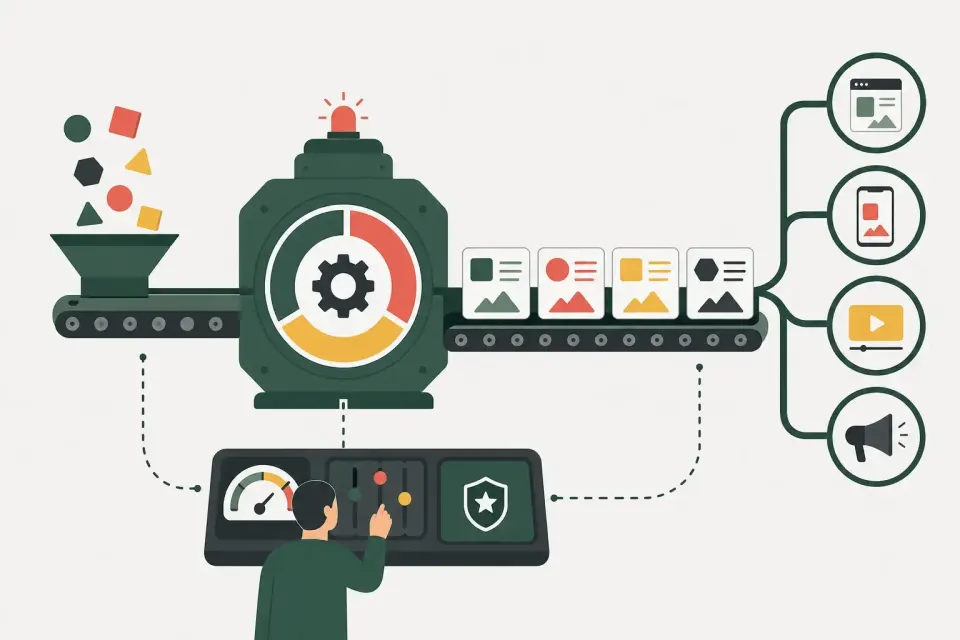
Wyndham Hotels & Resorts, Opella and BetMGM are among a growing tier of advertisers building in-house AI creative teams to mass-produce digital assets, reporting dramatic output gains while exercising selective guardrails on automated content.
AI-generated news summaries are cutting direct traffic to publisher websites while deepfakes and misinformation are driving up the cost of fact-checking. A Pew Research finding cited by The Guardian shows AI Overviews dramatically reduce user engagement with traditional search results, and wire services such as AFP are expanding verification teams to counter a surge in AI-generated disinformation.
A September 2026 post published on FuturistsSpeakers.com argues that algorithmic gatekeeping — the growing role of automated systems in determining what information and opportunities people can access — is becoming more influential across employment, finance, media, and commerce, raising concerns about transparency, bias, and the need for human oversight.
OpenAI updated ChatGPT's memory system in June 2026, replacing manual "remember this" commands with an automated profiling process the company calls "dreaming." The chatbot now independently decides what to retain from conversations, raising accuracy and control concerns for business professionals.
Demandbase has introduced Mojo, an AI agent designed to convert a stated B2B marketing strategy into a live, cross-channel campaign and continuously refine execution based on performance signals, marking a shift from task-specific AI tools toward fully agentic campaign management.
Google's Lighthouse 13.5 introduces an experimental audit for Agentic Resource Discovery (ARD), a proposed specification that enables AI agents to locate tools and services offered by a website. The audit is grouped under a new "Agent Discoverability" heading alongside the existing llms.txt audit, and is expected to roll out in Chrome 156 DevTools and PageSpeed Insights within two weeks.
NoimosAI, developed by AGOS LABS TECHNOLOGIES LTD, has introduced a Customer Engagement Agent that allows marketers to describe campaign goals in plain language and have the AI automatically generate behavior-based engagement flows, covering segmentation, email content, branching logic, and performance tracking.
Nestlé has appointed WPP to design and operate a centralized AI-driven content operating model across its Greater China brand portfolio, targeting production of more than 35,000 content pieces annually and connecting social, commerce, media and production through a single orchestration layer powered by WPP Open | China.
Conversational AI tools are fragmenting the traditional retail search journey, forcing brands to rethink how they structure product data, create content, and measure visibility. Experts say success now hinges on verified product knowledge graphs, schema markup, and cross-functional teams — not keyword density and backlinks.
A new roundup published by Explosion.com identifies ten LinkedIn marketing agencies redefining B2B lead generation by prioritising pipeline contribution over platform-native engagement metrics, with relevance, ICP precision, and multi-channel coordination emerging as the defining differentiators heading into 2026.