Newly unsealed court filings in The New York Times' copyright lawsuit against OpenAI and Microsoft allege that senior figures at both companies were aware of efforts to access paywalled content and use copyrighted material to train AI models. Internal documents cite a Microsoft executive describing the practice as an "astonishing theft of unprecedented proportions" and internal data suggesting AI-powered search could reduce publisher traffic by up to 93%.
Conversational AI tools are fragmenting the traditional retail search journey, forcing brands to rethink how they structure product data, create content, and measure visibility. Experts say success now hinges on verified product knowledge graphs, schema markup, and cross-functional teams — not keyword density and backlinks.
R/GA is launching the BRDNA Sequencer in September 2025, a platform-agnostic system that encodes a company's brand guidelines into structured instructions usable by AI creative tools, enabling teams to produce on-brand marketing assets without restating rules for every prompt.
EMARKETER principal analyst Sky Canaves says AI is adding complexity to the consumer purchase journey rather than collapsing it, with shoppers using AI primarily for mid-funnel research while social media overtakes search engines for product discovery.
A University of Illinois Urbana-Champaign preprint studying 30,000 Reddit AI search answers found that already-upvoted, formally written comments were far more likely to be selected than comments rich in personal experience—and that most first-person language was stripped in the final answers.
Google and DeepMind researchers have introduced Dream-RSI, a technique that allows AI agents to test alternative search strategies by replaying recorded past attempts rather than running costly new computations. Benchmarked on Gemini 3.1 Pro and Gemini 3.7 Flash across eight tasks, the method matched or outperformed baselines while sharply reducing the number of live attempts required.
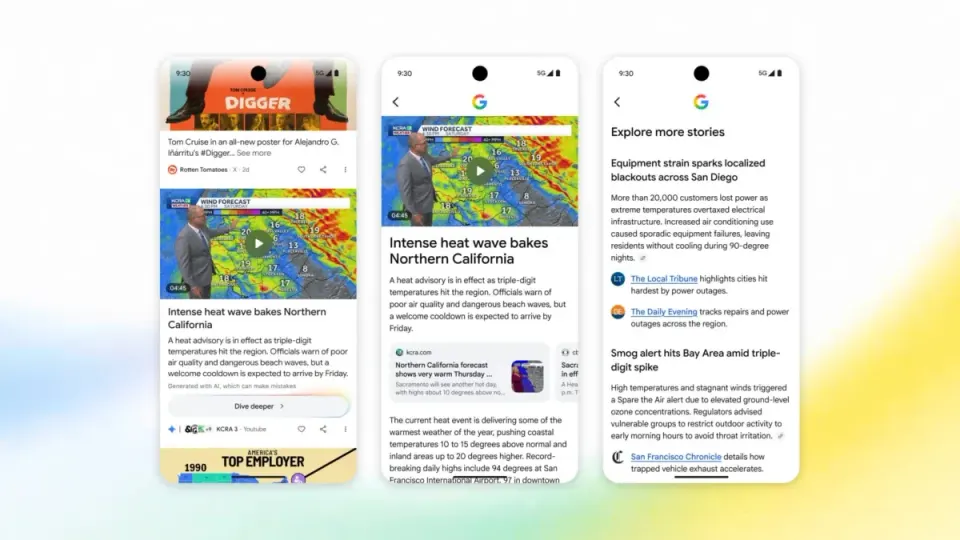
Google is rolling out an experimental "Dive deeper" feature in Google Discover that presents users with an AI-generated topic overview before linking to publisher articles, prompting concern from content creators and SEO professionals about potential declines in referral traffic.
Regina Moura, head of corporate communications at Roche Pharma Brazil, argues that generative AI has fundamentally shifted the rules of digital visibility: earned media and source credibility now drive brand presence, replacing keyword volume as the dominant currency of search.
A new roundup published by Explosion.com identifies ten LinkedIn marketing agencies redefining B2B lead generation by prioritising pipeline contribution over platform-native engagement metrics, with relevance, ICP precision, and multi-channel coordination emerging as the defining differentiators heading into 2026.
A new arXiv preprint testing GPT-5.4's citation behavior found that while top-ranked sources are cited far more often in raw data, deliberately swapping source order produced a much smaller and statistically insignificant effect — suggesting observed position gaps largely reflect content quality rather than rank alone. Structured formatting showed a modest but inconclusive citation lift, and model randomness caused citation decisions to flip in roughly one in seven reruns.
A new Search Engine Journal survey of search professionals finds that organic traffic is declining for many teams while conversions hold steady, and that budget plans are tilting sharply toward generative engine optimization (GEO) even though fewer than one in ten marketers feel confident measuring AI visibility.
Nasdaq-listed Datasea Intelligent Technology has shifted its AI agent digital marketing services from pilots to active delivery, with five customers now consuming services under arrangements that could represent up to approximately US$89.4 million in annualized service volume at maximum usage — though the company stresses the figure is not guaranteed revenue or contracted backlog.