Google, Cloudflare, and Microsoft Race to Build AI Content Payment Models — But Key Details Remain Opaque
Google, Cloudflare, and Microsoft are each piloting distinct systems to compensate publishers whose content powers AI-generated responses, but the three approaches differ significantly in how value is defined, what controls site owners hold, and how transparent the resulting data is.

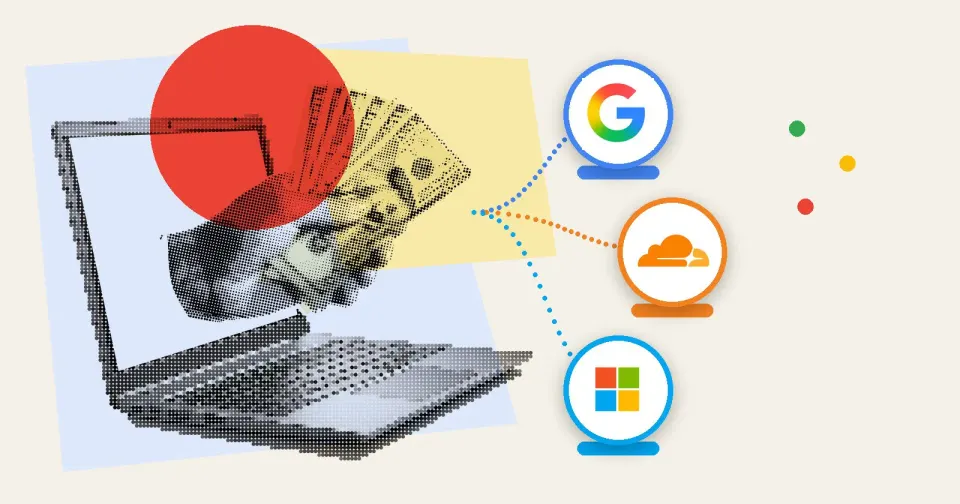
Three of the web's most powerful infrastructure and platform companies — Google, Cloudflare, and Microsoft — are simultaneously testing ways to pay publishers and website owners for AI access to or use of their content. Yet the mechanics of each program diverge sharply, raising pointed questions for content owners about what they can negotiate, what they can monitor, and what risks come with participation.
Google's Contribution Pilot: Invitation-Only, Google-Defined Value
Google's pilot pays when a site's content "contributes significantly" to an AI-generated response across its Gemini, AI Overviews, and AI Mode products, according to reporting by Digiday. The program is by invitation only, and participants can opt in or out at any time through Search Console. Monthly earnings and some history are visible in an AI contribution panel within Search Console, but Digiday notes that no additional details on how payouts are calculated are provided.
Crucially, Google — not the publisher — determines whether content qualifies. Digiday's sources describe the methodology as opaque: "It's quite black box," one exec with knowledge of the program told Digiday. Google has not publicly stated the criteria it uses. One executive told Digiday the numbers offered to their company and several peers were too low to opt in, and that talks with Google were ongoing.
Google frames the pilot as supplementary to existing programs. According to the source article, Google states that their News AI pilot involves over 200 publications, the European News Partnerships program pays more than 5,500 European publications, and News Showcase partners with more than 2,800 outlets across 33 countries. Google gave Digiday no expansion date for the pilot and describes it as still being in the early stages.
Cloudflare's Dual-Track Approach: Mechanical Triggers and Partner Models
Cloudflare has been developing two related but distinct payment mechanisms. Its Pay Per Crawl product, which has been in private beta since 2025, charges a crawler for each successful retrieval. The site owner sets a per-crawl price, with a $0.001 minimum, and a crawler that agrees to pay receives the page with an HTTP 200 response. Site owners can also choose per crawler whether to charge, allow, or block.
However, Cloudflare has signaled that the per-fetch model has limits. A July post from the company notes that crawling turned out to be a crude measure of value, because a page can be crawled once and cited in thousands of answers, or crawled over and over and never used. Cloudflare is therefore shaping a second product, Pay Per Use, where AI companies bring their own payment models. Cloudflare describes Pay Per Use as an experiment and says it has a lot to learn about this model's performance across the internet.
Under Pay Per Use, Ceramic.ai pays participating sites when their content appears in its search results, providing reports on the top queries that surfaced their content, including the specific page, snippet, and average position. You.com pays on demand for a specific piece of premium content. Cloudflare's dashboard shows crawler activity under Pay Per Crawl, but the same documentation notes that the earned balance isn't displayed on the dashboard and needs to be requested from the Cloudflare team.
Microsoft's Publisher Content Marketplace: Publisher-Defined Terms, Unspecified Detail
Microsoft announced its Publisher Content Marketplace on February 3, providing licensing for premium content to support Copilot responses. Microsoft stated that publishers will be paid on delivered value, define licensing and usage terms, and receive usage-based reporting. Copilot is the first demand partner, and Yahoo was onboarding at announcement. The post describes joining as voluntary and states that publishers keep ownership of their content and keep their editorial independence.
Despite those assurances, the marketplace's specifics remain publicly undefined. Microsoft's announcement does not specify the payable unit, and the post doesn't say what the usage-based reports contain.
SEO Risk and the Googlebot Question
A significant tension exists for sites that use Cloudflare's crawler controls. Cloudflare's documentation warns that setting search engine crawlers to Block or Charge may hurt SEO performance because search engines may not be able to index the content. Google's crawler documentation states it doesn't use content from URLs returning 4xx status codes, and that indexed URLs returning any 4xx other than 429 are removed from the index over time — a category that includes a 402 Payment Required response.
A September 15 Cloudflare post introduced a "Disallow AI Training" setting that publishes a no-training preference in robots.txt that Google and Apple honor while their crawlers keep crawling for search. For Microsoft's Bing, Cloudflare says Microsoft is building robots.txt support targeted for early 2027. Cloudflare reports that less than 1% of its sites block search bots, while 17% use some form of training block.
What Publishers Say They Need
Publisher advocates are pushing for greater transparency across all three systems. David Buttle from the publisher coalition Spur said the first step is setting the precedent that publishers deserve to know when their content informed a response. One participant in Google's pilot mentioned to Digiday that they would like a feedback system like Search Console for search, but for AI inference — a level of detail that no current system fully delivers.
Cloudflare plans to make its search-signals program broadly available later this year and aims to give sites the ability to decide how much of their content appears in AI summaries by early next year. Google expects to introduce URL-level Google-Extended transparency tools within a few weeks, though these are distinct from the pilot's contribution reporting.
Prepared with AI assistance and reviewed by the editorial team.